Can I Hang a Heavy Bag From Basement Ceiling Joists?

Time:2026-10-09 Author:Amelia
0%

Can I hang a heavy bag from my basement ceiling joists? Yes, sometimes—but the answer depends on the framing, hardware, and bag movement. A filled heavy bag can weigh 70 to 150 pounds. Punching adds repeated, downward, and sideways forces. The ceiling may look solid while hiding weak connections, cracked lumber, or undersized joists.

Veteran boxing coach and gym designer Ross Enamait puts it plainly: “The bag is only as safe as the structure holding it.” That principle matters in a basement. A single lag screw placed into drywall or the joist’s edge is not enough. The mounting point should connect directly to sound framing. Reinforcing nearby joists with properly fitted blocking can reduce twisting and vibration. A commercial heavy-bag bracket may also spread the load more effectively.

Look closely.

Before drilling, inspect the joists from below. Check their size, spacing, span, and condition. Avoid damaged, notched, or visibly sagging wood. Use hardware rated for the expected load and movement. Follow the bracket manufacturer’s instructions, not a guess from an online video. If the bag swings aggressively, a floor stand or dedicated frame may be safer.

I once assumed a heavy bag only pulled straight down. That was incomplete. Every strike can create movement through the entire ceiling assembly. A structural engineer or experienced contractor should review uncertain framing. The safest installation is not always the quickest one. A little hesitation here can prevent falling equipment, damaged drywall, or a serious injury.
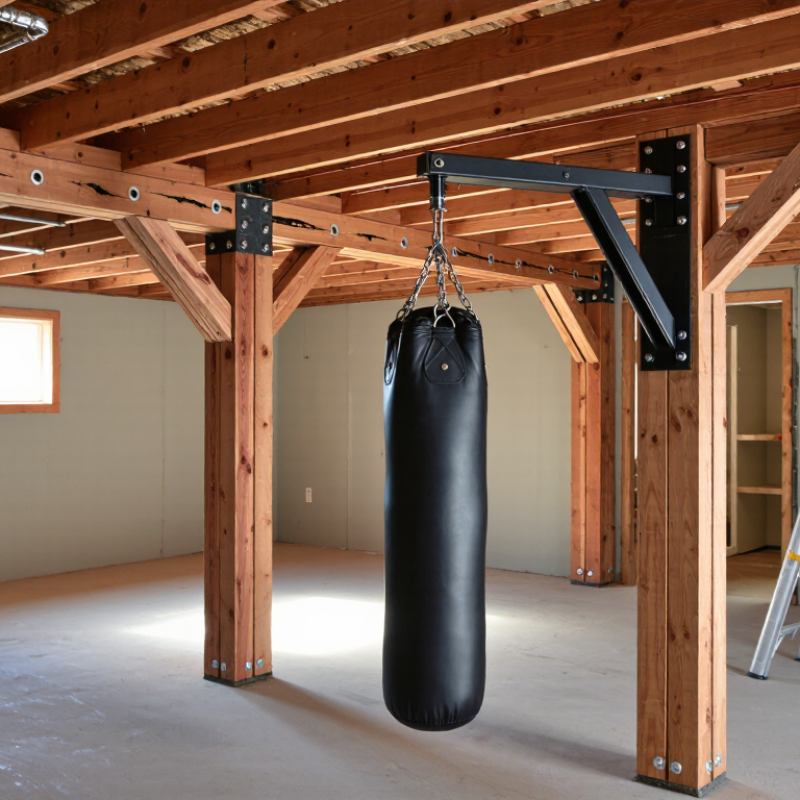
Can I Hang a Heavy Bag From Basement Ceiling Joists?

Define Bag Weight and Use a 2–3× Dynamic Load Design Factor

A heavy bag can hang from basement ceiling joists, but the bag’s listed weight is only the starting point. A 100-pound bag may create 200 to 300 pounds of force during hard strikes, swinging, or sudden stops. Use a 2–3× dynamic load design factor when evaluating the support.

The force does not stay directly beneath the hanger. It travels through the mounting plate, bolts, joist, and nearby framing. Inspect the joists for cracks, rot, water damage, drilling, or excessive sag. A single joist may be inadequate, especially when the bag swings sideways. Spreading the load across multiple joists with properly sized blocking can reduce stress, but only when the framing can safely accept those connections.

Use structural fasteners that match the wood and connection design. Avoid relying on drywall, light-duty hooks, or small lag screws placed near a joist edge. Pull on the installed support before hanging the bag, then test it with gentle movement. My first estimate is often too optimistic when I ignore vibration and repeated impact. A structural engineer or experienced building professional should review uncertain framing, older homes, or unusually heavy bags. The ceiling may look solid. That proves very little.

Check Joist Size, Span, Spacing, and Deflection Limits

Can I Hang a Heavy Bag From Basement Ceiling Joists?

A basement ceiling can hide either floor joists or lighter ceiling framing. That distinction matters. A heavy bag creates repeated impact loads, not just a steady hanging load. The International Residential Code, Table R301.5, lists residential floor live loads by room use, commonly 30 or 40 pounds per square foot. However, those values describe distributed loads, not concentrated punching forces.

Check the joist species, grade, size, spacing, and clear span. The American Wood Council span tables show that allowable spans change sharply with these details. A 2-by-10 joist may perform differently from another 2-by-10 joist. Deflection is also important. Common design limits use L/360 for live loads and L/240 for total loads. Excess movement may cause cracking, vibration, or loose connections. I once saw a bag mount remain tight while the joist slowly split around the bolts. It looked safe. It was not.

Tips: Measure the unsupported span, then identify spacing, often 12, 16, or 24 inches on center. Do not rely on drywall anchors. Use a properly sized through-bolt assembly across sound lumber, away from knots and damage. A spreader frame can share force across several joists, but it still needs structural review. The AWC National Design Specification warns that connection capacity depends on fastener type, edge distance, and wood condition. If the bag feels springy, the framing may be undersized. Stop and ask a licensed structural engineer to verify the joists and deflection.

Compare Loads With IRC R301.5’s 300-Pound Concentrated-Load Benchmark

Can I Hang a Heavy Bag From Basement Ceiling Joists?

IRC R301.5 lists a 300-pound concentrated-load benchmark for many floor areas. This figure is useful for comparison, not automatic permission. A heavy bag may weigh 100 pounds, but each punch creates sudden movement and rebound. The framing can experience much higher forces than the bag’s resting weight. Ceiling joists also differ in span, spacing, species, grade, and condition. A joist supporting drywall may not safely carry repeated impact loads. Check the entire load path, including the hanger, fasteners, joist, and supporting wall or beam.

From practical framing inspections, the weakest point is often the connection. A single lag screw near an edge can split wood or loosen over time. Two adjacent joists may share the load, but only when properly connected. Blocking between joists can reduce twisting, yet it does not magically increase structural capacity. I would inspect for cracks, notches, water damage, and excessive sag before installing anything. My first assumption might be too optimistic, especially in an older basement.

Tips: Use the 300-pound benchmark as a warning line, not a target. Identify the joist size and span, then ask a qualified structural professional to review the installation. Choose a location over a beam or bearing wall when possible. Use rated hardware and follow its installation requirements. Leave clearance around the bag. A freestanding frame may be safer when the ceiling framing cannot be verified. Local code adoption can differ, so confirm the applicable IRC edition with your building department.

Distribute the Mount Across Multiple Joists With Rated Hardware

Can I Hang a Heavy Bag From Basement Ceiling Joists?

Basement joists can support a heavy bag, but punching creates repeated, shifting loads. One joist is rarely enough. A single attachment point may twist the wood, loosen hardware, or transfer vibration into the ceiling.

Use a solid mounting plate that spans at least two, preferably three, joists. Center the plate so each joist receives part of the load. Install structural bolts with large washers, and choose hardware rated for overhead, dynamic loading. Do not rely on drywall, ceiling panels, or one lag screw. Rated hardware matters.

Inspect the joists before drilling. Look for cracks, water damage, notches, and nearby pipes or wiring. Predrill carefully, then tighten the bolts evenly without crushing the wood. Add solid blocking between joists when the layout allows it. The bag should hang from the plate, not from a thin ceiling surface.

Test the installation gradually. Start with gentle taps, then increase force while checking movement, creaking, and bolt gaps. A little noise can reveal a larger problem. I once underestimated vibration and had to reinforce the mounting area later. That mistake was avoidable. If the joists seem undersized or damaged, ask a qualified structural professional to inspect the load path before installation.

Inspect Connections and Perform a Controlled Load Test Before Training

Can I Hang a Heavy Bag From Basement Ceiling Joists?

A heavy bag creates repeated impact, not just a steady downward load. Inspect the ceiling framing before drilling anything. Look for split wood, water stains, insect damage, loose nails, and sagging joists. Check the connection between each joist and the supporting beam or wall. A strong-looking joist may still have a weak bearing point.

Use a solid mounting location that crosses multiple joists when possible. Add properly fitted blocking between joists to reduce twisting and vibration. Fasteners must suit the wood size and connection design. Avoid relying on drywall, trim, or a single small screw.

Engineered joists require extra caution because drilling or cutting them can weaken the structure. A qualified structural professional should review uncertain framing.

Test the installation gradually. Hang the empty bag first, then add weight in small steps. Watch the mount, joists, blocking, and nearby ceiling for movement or cracking. Push the bag gently before striking it.

Stop if bolts shift, wood creaks sharply, or deflection remains visible. Keep people away from the test area.

My own inspection habit is imperfect: I once focused on the joist and overlooked a loose connection above it. That mistake changed the way I check every attachment. Dynamic training can expose weaknesses that a quiet load never reveals.

FAQS

Can a basement ceiling joist safely support a heavy bag?

Not automatically. A 100-pound bag can create much higher forces during punches and rebound.

Does the 300-pound concentrated-load benchmark approve this installation?

No. Treat it as a warning line, not a target or automatic approval.

What parts of the structure should I inspect?

Check the hanger, fasteners, joists, blocking, beam, and supporting wall. The entire load path matters.

Which warning signs suggest the framing may be unsafe?

Look for splits, water stains, insect damage, notches, loose nails, sagging, and sharp creaking.

Is one lag screw enough for mounting a heavy bag?

Usually, relying on one small screw is risky. It may split the wood or loosen under repeated movement.

Can mounting across two joists improve stability?

It can distribute movement when properly connected. Add fitted blocking to reduce twisting and vibration.

How should I test the mounting system?

Start with an empty bag. Add weight gradually, then push it gently before striking it.

What movements mean I should stop testing?

Stop if bolts shift, cracks appear, sharp creaks sound, or visible deflection remains.

What if the ceiling framing cannot be verified?

Consider a freestanding frame. It may be safer than drilling into uncertain or engineered framing.

What mistake can happen during inspection?

I might focus on the joist and miss a loose connection above it. Quiet loads can hide weaknesses.

Conclusion

Can I hang a heavy bag from my basement ceiling joists? The answer depends on more than the bag’s listed weight. First, account for the bag, mounting hardware, and the force created by repeated punches and kicks. A practical design approach is to evaluate the support system using a dynamic load factor of roughly two to three times the static weight. Then inspect the joists for size, span, spacing, existing damage, and acceptable deflection. A flexible or undersized framing system may require reinforcement before installation.

To reduce stress, connect the mount across multiple joists with properly rated hardware rather than relying on one point. As a reference, IRC R301.5 includes a 300-pound concentrated-load benchmark, but actual suitability still depends on the framing layout and how the bag is used. Before training, inspect every connection, tighten fasteners, and perform a gradual, controlled load test while watching for movement, cracking, or excessive vibration. If any uncertainty remains, consult a qualified structural professional.

Amelia

Amelia

Amelia is a seasoned marketing professional with a wealth of expertise in our company’s core offerings. With an unwavering passion for driving growth and innovation, she plays a pivotal role in shaping our marketing strategies and enhancing brand visibility. A key aspect of her responsibilities......